

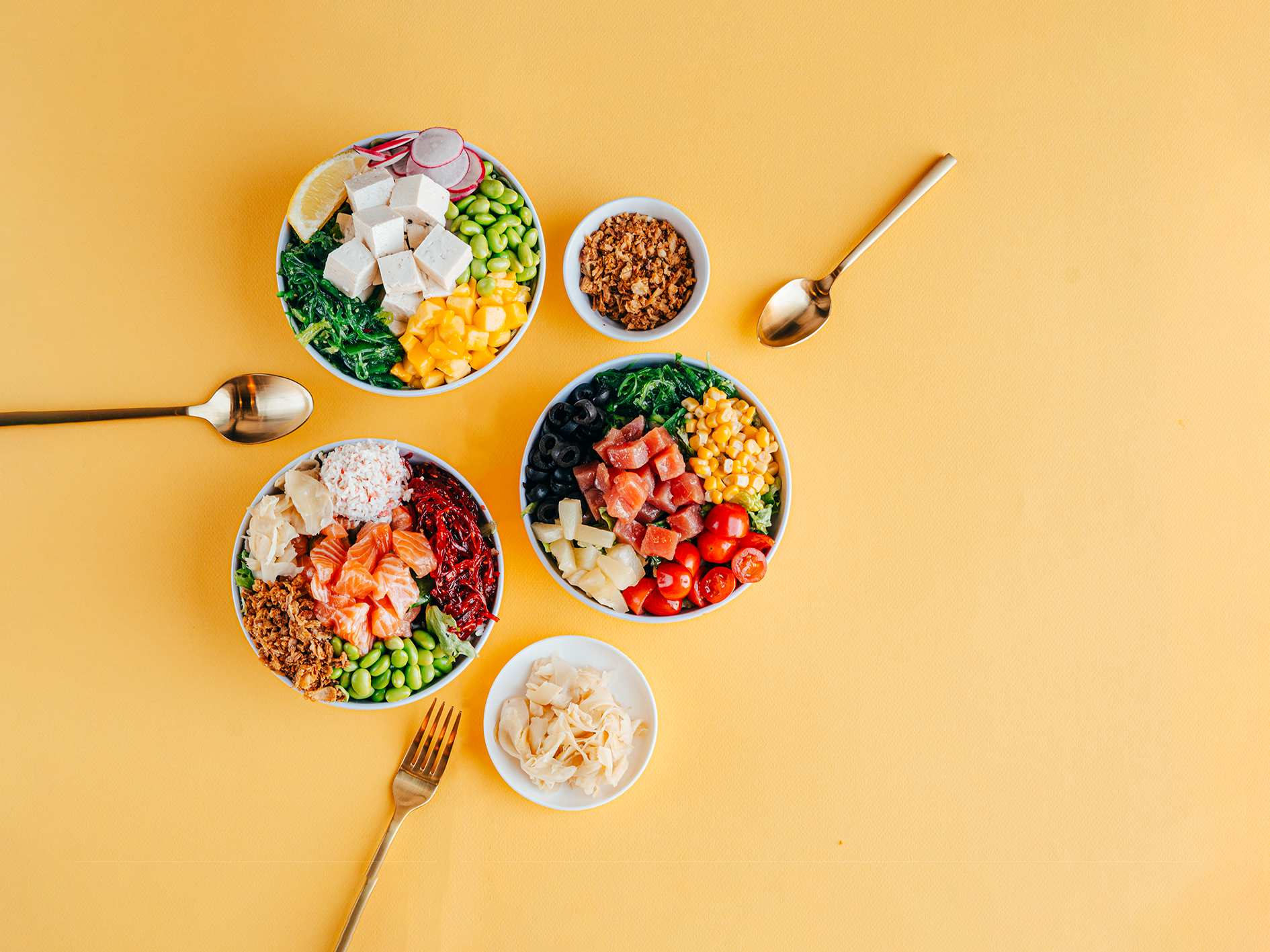
New to Pokerrito? Start Here.
Torched warm bowls, classic poke, sushi burritos, or build your own. Here is the simplest way to decide what to order on your first visit to Pokerrito, plus the three dishes first time guests pick most.
Fresh poke, torched warm bowls, sushi burritos, and more. Here’s what to try first.
Trying Pokerrito for the first time? You’re not alone.
One of the best things about Pokerrito is that there’s more than one way to enjoy it. But that also means first time guests sometimes ask the same question: Where do I start?
If you’re new to Pokerrito, here’s the easiest way to think about the menu. At its core, Pokerrito gives you four main ways to enjoy your meal:
So instead of asking, “What should I order?” start with this question instead: What are you in the mood for?
Want it warm? Start with a Torched Warm Bowl.
If you’re craving something warm, savoury, and comforting, this is the best place to start. Our Torched Warm Bowls combine warm rice, freshly prepared proteins, and bold flavours inspired by Asian cuisine, finished with heat.
They’ve become one of the most popular ways to enjoy Pokerrito, especially when you want something a little more satisfying than a cold lunch. Here is more on how torched poke works.
Good first picks:
Miso Glazed Salmon
Bulgogi
Torched Ahi Tuna
If you’re new and not sure what to choose, these are strong places to start.
Want it fresh? Go with a Classic Poke Bowl.
Fresh poke is where Pokerrito began. If you want something lighter, cleaner, and closer to the traditional poke experience, a Classic Poke Bowl is the move. You’ll get fresh ingredients, signature sauces, and a balance of flavour and texture that makes poke so easy to love.
Great for:
a lighter lunch
fresh, clean flavour
fans of classic poke
If you like your meal bright, fresh, and packed with quality ingredients, this is probably your category. See how Korean style and Japanese style poke differ.
Want it handheld? Try a Sushi Burrito.
Not in the mood for a bowl? Our Sushi Burritos take everything people love about poke and wrap it in nori for a handheld format you can grab and go. It’s fresh, filling, and easy to eat, especially if you want something portable or just want a different experience from the usual bowl.
Best for:
meals on the go
something different
poke in a handheld format
And yes, this part of the menu is also where the Pokerrito name comes from: Poke + Burrito = Pokerrito.
Want it your way? Build Your Own.
If you already know what you like, or you want more control over your meal, Build Your Own is the best option. Choose your base, protein, sides, sauce, and toppings to create something that fits your taste.
This is a great choice if:
you know your favourite ingredients
you want a specific sauce combination
you like customizing your meal
It’s also one of the easiest ways to explore Pokerrito your own way.
Still not sure? Start with these.
If you just want the short answer, here are some easy first picks:
For a warm bowl: Miso Glazed Salmon or Bulgogi
For a fresh bowl: Choose one of our classic poke favourites
For something handheld: Try a Classic Pokerrito
For customization: Go with Build Your Own
You really don’t need to overthink it. The best place to start is simply choosing the format that fits your mood. Want more detail? Read our full guide by craving.
What makes Pokerrito different?
Pokerrito was founded in Vancouver in 2016 and started with fresh poke bowls and sushi burritos. Over time, the menu evolved, and today, Torched Warm Bowls have become a defining part of the Pokerrito experience.
That means you don’t have to choose between fresh and comforting. At Pokerrito, you can have both.
TORCHED. WARM. FRESH.
New to Pokerrito? Here’s the simplest way to choose.
Want it warm? Try a Torched Warm Bowl.
Want it fresh? Go with a Classic Poke Bowl.
Want it handheld? Choose a Sushi Burrito.
Want it your way? Build Your Own.
That’s it. And once you’ve tried your first Pokerrito, you’ll probably already know what you want next time.
Ready to Try Pokerrito?
Explore the menu and find your first favourite.
10 Years. Two Ways to Celebrate.
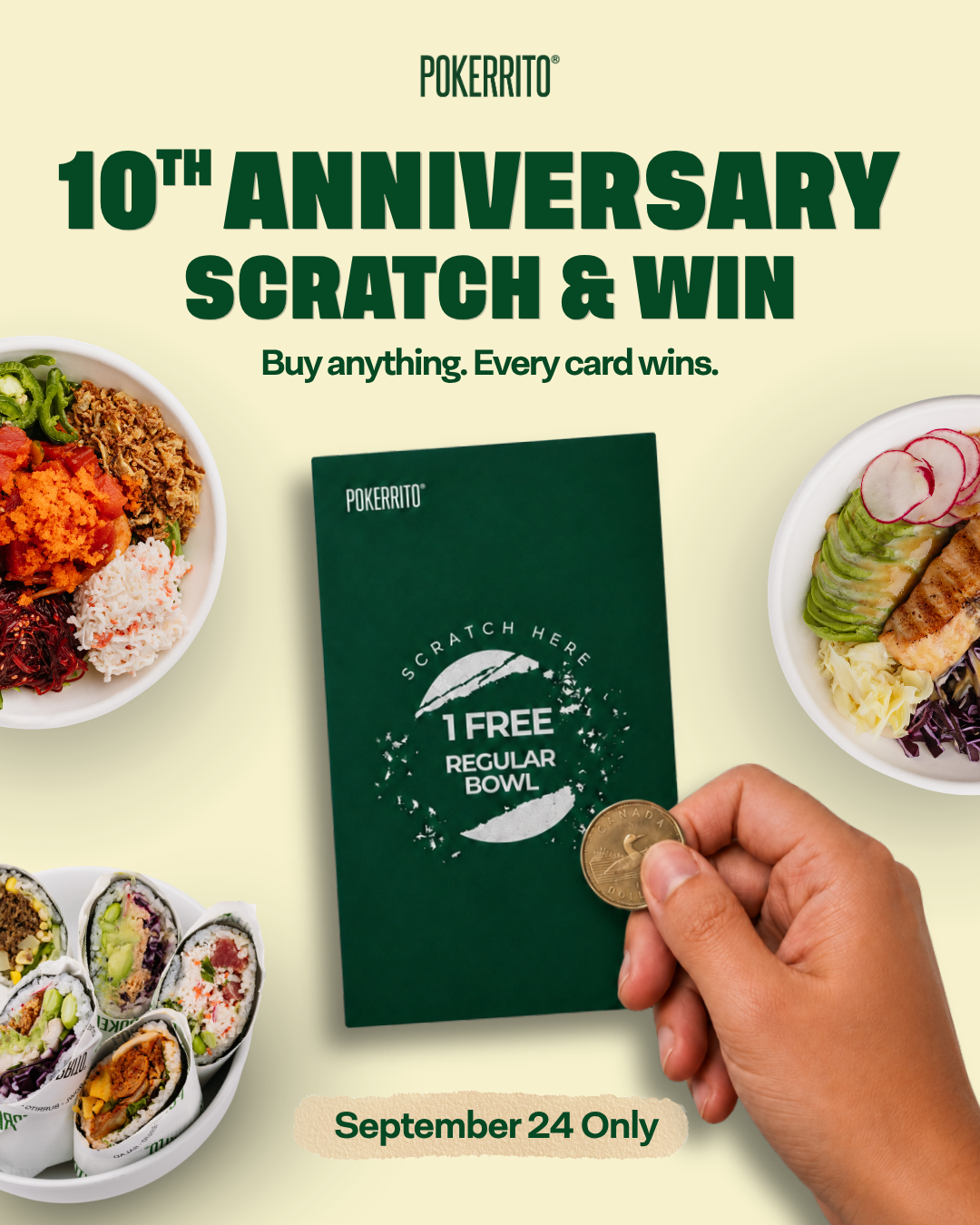
For one day only, September 24, Pokerrito is celebrating 10 years with Regular Classic Poke Bowls back to $10.95 and a Scratch & Win card that always wins.
SEPTEMBER 24 ONLY
$10.95 Classic Bowls + Scratch & Win.
Ten years of fresh bowls, bold flavours, and you. Celebrate Pokerrito’s 10th anniversary with two reasons to stop by.
One day. Two anniversary treats.
Back to $10.95
Regular Classic Poke Bowls return to their original 2016 price for one day only.
Scratch & Win
Make a purchase on September 24 and receive a Scratch & Win card at checkout. Every card wins — a little thank you for being part of our story.
Plan your visit
WHEN
September 24, for one day only.
WHERE
In store at all Pokerrito locations across Canada.
HOW
Place an eligible order and collect your Scratch & Win card at checkout.
Good to know
What do I need to buy to get a card?
Any purchase qualifies. Every eligible order comes with a Scratch & Win card, and every card wins.
Which bowls are $10.95?
The anniversary price applies to Regular Classic Poke Bowls on September 24 only.
Can I join at my local Pokerrito?
Yes. The promotion runs in store at all Pokerrito locations across Canada.
Celebrate with us.
Find your nearest Pokerrito and join us on September 24.

Poke Bowl vs Sushi Burrito: What’s the Difference?
A poke bowl is a deconstructed Hawaiian dish served in a bowl with rice or greens, fresh fish, and toppings — eaten with a fork or chopsticks. A sushi burrito — also called a poke burrito — is a hand-held fusion creation that wraps the same ingredients inside a sheet of roasted nori. At Pokerrito, we're known for both — in fact, our signature poke burrito is what gave us our name: the Pokerrito.
If you've stood at the counter wondering which to order — or scrolled our menu trying to figure out what makes them different — this guide is for you. We've been serving both at Pokerrito since opening our first shop on Dunsmuir Street, Vancouver, in 2016. The question comes up almost every shift.
Here's everything you need to know.
Quick Comparison: Poke Bowl vs Sushi Burrito (Pokerrito)
Same fresh ingredients, very different experiences:
Format: Poke bowl = open bowl, layered. Sushi burrito / poke burrito (Pokerrito) = wrapped in roasted nori, hand-held.
Origin: Poke bowl = Hawaii (traditional). Sushi burrito / poke burrito = West Coast fusion, popularized ~2011.
How you eat it: Bowl = fork or chopsticks. Pokerrito = hands, end to end.
Portability: Bowl = sit-down friendly. Pokerrito = built for on-the-go.
Base options: Bowls offer white rice, brown rice, mixed greens, romaine, or kale noodle. Pokerritos use sushi rice inside roasted nori.
Portion: Bowls are customizable, fit a meal-prep container. Pokerritos are a single fixed-size roll.
Signature builds (both formats): North Shore, Diamond Head, Hanauma, Sunset Beach, Hawaiian Classic.
Warm option: Bowls have Torched Warm Bowls (Bulgogi Bowl is a bestseller). Pokerritos have the Warm Pokerrito — torched, warm proteins.
Best for: Bowls = office lunch, meal prep. Pokerritos = walking, commuting, one-handed eating.
What Is a Poke Bowl?
A poke bowl (pronounced POH-kay, not "poke") is a traditional Hawaiian dish that dates back centuries. The word poke means "to slice or cut" in Hawaiian — referring to how the fish is prepared.
The classic version starts with a base of warm rice, topped with cubed fresh fish (usually ahi tuna or salmon) that's been marinated in soy sauce, sesame oil, and aromatics. From there, you layer on toppings: edamame, seaweed salad, pineapple, masago, furikake, crispy onions, and a finishing sauce.
The modern poke bowl — the version you see at fast-casual restaurants across North America — emerged in the early 2010s as Hawaiian poke shops spread to the mainland. The format stayed the same: an open bowl, fully customizable, eaten with a fork or chopsticks.
What defines a poke bowl at Pokerrito:
Choose from five bases: white rice, brown rice, mixed greens, romaine, or kale noodle
Pick a Classic Poke Bowl (North Shore, Diamond Head, Hanauma, Sunset Beach, or Hawaiian Classic) or Build Your Own with 50+ combinations
Every protein is sourced through the Ocean Wise sustainable seafood program
Designed to be enjoyed at a table — though it travels well in a takeout container
What Is a Sushi Burrito or Poke Burrito? (And Why We Call Ours a "Pokerrito")
"Sushi burrito" and "poke burrito" are two names for the same thing — a hand-held roll that takes sushi-style ingredients and wraps them in an oversized sheet of nori (or soy paper) so you can eat it like a Mission-style burrito. The format was popularized in San Francisco around 2011 and quickly spread up and down the West Coast. Some restaurants call it a sushi burrito; others prefer poke burrito because the fillings lean toward Hawaiian poke. Either name refers to the same wrapped, hand-held creation.
When we opened in Vancouver in 2016, we took that idea and built our entire brand around it — combining Hawaiian poke with the portability of a burrito and seasoning the fillings with bold pan-Asian flavours like Korean bulgogi, spicy gochujang pork, and wasabi basil. We called the result the Pokerrito — poke + burrito — and it became our signature.
Today we serve two distinct versions:
Classic Pokerrito — the original cold sushi burrito (a.k.a. poke burrito) with fresh fish, wrapped in roasted nori. Same five signature builds as our bowls (North Shore, Diamond Head, Hanauma, Sunset Beach, Hawaiian Classic).
Warm Pokerrito — Canada's original warm poke burrito. Filled with torched warm proteins like roasted chicken, miso-glazed salmon, bulgogi beef, or spicy Korean pork, all wrapped in soft roasted seaweed.
What defines a sushi burrito / poke burrito:
Wrapped in roasted nori — hand-held by design
Eaten without utensils, end to end
Typically a fixed size (no half-portions — the wrap needs structural integrity)
At Pokerrito, available cold (Classic Pokerrito) or warm (Warm Pokerrito)
The 7 Key Differences Between Poke Bowls and Sushi Burritos
Even when the ingredients overlap completely — as they do at Pokerrito, where our bowls and burritos share the same proteins, toppings, and sauces — the eating experience is different. Here's a closer look.
1. Format and presentation. A poke bowl is open — every layer visible. A sushi burrito (or poke burrito) is wrapped — you only see the outer nori until you bite into it. This affects everything from how you photograph it (bowls win on Instagram) to how messy it gets (burritos contain themselves).
2. Origin and cultural roots. Poke is a traditional Hawaiian food with hundreds of years of history. Sushi burritos are a 2010s West Coast fusion invention. One has lineage; the other has innovation. The Pokerrito leans into both — our menu pulls equally from Hawaiian poke tradition and Korean fusion influences.
3. How you eat it. Bowls require a fork or chopsticks. Burritos require nothing. If you're at your desk, on a commute, or walking between meetings, the Pokerrito wins on logistics.
4. Portion control. Bowls let you mix bases — half rice, half greens is a popular Pokerrito move. Sushi burritos are usually a single fixed size because the wrap has to hold together structurally.
5. Sauce distribution. In a bowl, sauce sits on top and you can stir it through. In a Pokerrito, sauce is distributed inside the roll and you taste it in every bite. Burritos tend to feel more "blended"; bowls feel more "layered." This matters most with our bolder sauces — sweet chili gochujang, wasabi basil, and creamy mayo all behave differently between the two formats.
6. Temperature. Classic poke bowls and Classic Pokerritos are served cold. Warm Pokerritos and Torched Warm Bowls are the exception — they're finished with warm proteins and a torch, giving you a hot meal in a sushi format. That's something most poke shops can't offer.
7. Meal occasion. Bowls suit sit-down lunch, meal prep, and family-style sharing. Pokerritos suit grab-and-go, commuting, and one-handed eating during another activity. Many of our regulars order a bowl for the office and a poke burrito when they're walking between meetings.
Which Should You Order? A Quick Decision Guide
Choose a poke bowl if:
You're eating in the restaurant or at your desk
You want to mix bases (rice + greens combo)
You like seeing your ingredients separated
You're meal-prepping (bowls keep better in the fridge)
Choose a Classic Pokerrito (cold sushi burrito / poke burrito) if:
You're eating on the move
You only have one hand free
You want everything in every bite, blended together
You love the original fresh-fish version
Choose a Warm Pokerrito (warm poke burrito) if:
You want comfort food without sacrificing the sushi format
The weather's cold, or you're craving warm proteins
You're trying our signature Korean fusion fillings (bulgogi, spicy pork)
You've never had a torched sushi burrito and you're curious
There's no wrong answer. All three pull from the same fresh, Ocean Wise–certified proteins and the same 50+ topping combinations. They're variations on the same idea.
Are Poke Bowls and Sushi Burritos Healthy?
Both can be excellent choices nutritionally — and the answer depends on what you build.
The healthy starting point is the same: lean protein (raw fish is high in omega-3s and complete protein), fiber-rich vegetables, and a controlled carb base. A typical Pokerrito poke bowl delivers around 24g of high-quality protein from ahi tuna or salmon, plus omega-3 fatty acids and a wide range of micronutrients from the vegetables. A typical poke burrito runs slightly higher in calories than a bowl, mostly because the wrapped format encourages a more generous portion.
The calorie variable isn't poke vs. burrito — it's what you add. Heavy sauces (creamy mayo, sweet chili gochujang) and crispy toppings (crispy onions, tempura) add up fast. Lighter sauces (ponzu, classic shoyu, umami) and pickled toppings keep things lean without sacrificing flavour.
If weight loss is the goal, swap white rice for kale noodle or mixed greens, choose one sauce instead of two, and skip the fried add-ons.
→ For the full nutrition breakdown, see our deep-dive: Is Poke Healthy? Nutrition Facts, Calories & Benefits.
Why Pokerrito Serves Both
When we opened our first Pokerrito on Dunsmuir Street in 2016, we made a deliberate choice not to pick a lane. Poke bowls and poke burritos answer different questions — "where am I eating this?" being the main one — and our guests shouldn't have to go to two different restaurants for two different occasions.
So we built our menu around a shared core: the same Ocean Wise–certified proteins, the same fresh toppings, the same house-made sauces, the same five signature builds (North Shore, Diamond Head, Hanauma, Sunset Beach, Hawaiian Classic). You choose your format at the counter — bowl, Classic Pokerrito, or Warm Pokerrito.
That's why we're called Pokerrito. Poke + burrito, all under one roof.
Today we operate 12 locations across British Columbia and Ontario, with our original Vancouver flagship on Dunsmuir Street and our newest at Commerce Court in downtown Toronto. We're proudly Canadian — and proudly the country's original sushi burrito (or poke burrito, if you prefer) brand.
Related Reading
Poke Bowl vs Sushi: What's the Difference? — How poke bowls compare to traditional sushi rolls and nigiri
Is Poke Healthy? Nutrition Facts, Calories & Benefits — Full nutrition breakdown with calorie math
Pokerrito in the Media: Vancouver's Original Poke Chain Since 2016 — Press coverage and brand history
FAQ
Is a poke burrito the same as a sushi burrito?
Yes. "Poke burrito" and "sushi burrito" are two names for the exact same dish — a hand-held roll wrapped in roasted nori, filled with sushi-style ingredients like fresh fish, rice, and vegetables. Restaurants use the names interchangeably; some prefer "poke burrito" because the fillings lean Hawaiian. At Pokerrito, we coined our own name for it — the Pokerrito — when we opened in Vancouver in 2016.
Are poke bowls and sushi burritos the same thing?
No. They share ingredients (fresh fish, rice, vegetables, sauces) but differ in format and origin. A poke bowl is a traditional Hawaiian dish served in an open bowl. A sushi burrito (also called a poke burrito) is a West Coast fusion format wrapped in roasted nori and eaten by hand. At Pokerrito, our signature poke burrito is called the Pokerrito — and it comes in both cold (Classic) and warm versions.
What is a Pokerrito?
A Pokerrito is our signature poke burrito (also called a sushi burrito) — fresh poke-style ingredients wrapped in roasted nori, designed to be eaten by hand. We invented the name (poke + burrito) when we opened in Vancouver in 2016. Today it comes in two versions: the Classic Pokerrito (cold, fresh fish) and the Warm Pokerrito (torched warm proteins like bulgogi or miso-glazed salmon).
What's the difference between a Classic Pokerrito and a Warm Pokerrito?
The Classic Pokerrito is cold — fresh fish, vegetables, and sauce wrapped in roasted nori, similar to a hand-held sushi roll. The Warm Pokerrito uses cooked, torched proteins (roasted chicken, miso-glazed salmon, bulgogi, spicy Korean pork) wrapped in soft roasted seaweed for a comfort-food experience.
Which is healthier, poke bowl or poke burrito?
Both can be equally healthy. The calorie total depends more on your choice of base, sauce, and toppings than on the format itself. At Pokerrito, choosing brown rice or kale noodle, a citrus-based sauce, and one indulgent topping keeps either option well under 600 calories. See our Is Poke Healthy? guide for a full breakdown.
Can you order a poke bowl or poke burrito without raw fish?
Yes. At Pokerrito, the Sunset Beach build is fully plant-based (fried tofu). You can also build either format with cooked proteins through our Warm Pokerrito and Torched Warm Bowls menus — roasted chicken, miso-glazed salmon, bulgogi beef, or spicy Korean pork.
Is the fish at Pokerrito sustainably sourced?
Yes. Every protein we serve is sourced through the Ocean Wise sustainable seafood program. We've been an Ocean Wise partner since our early days and consider it core to who we are.
How do you eat a sushi burrito without it falling apart?
Hold it with both hands and eat from one end, keeping the paper wrapper around the bottom half as you go. Don't try to unwrap it fully — the paper is part of what keeps the Pokerrito structurally intact. The Warm Pokerrito is a little softer than the Classic, so go slow on the first bite.
Is poke pronounced "poke" or "POH-kay"?
It's POH-kay (two syllables). The word comes from Hawaiian and means "to slice or cut," referring to how the fish is prepared.
Try Both at Pokerrito
The best way to settle the debate is to taste them side by side. Visit your nearest Pokerrito to build your own — bowl, Classic Pokerrito (cold poke burrito), Warm Pokerrito, or one of each.
Bring your own bowl and get 10% off — part of our commitment to sustainable packaging and our Ocean Wise partnership.